Industrial AI is becoming an architecture problem
As intelligence moves from software into machines and physical systems, the challenge is no longer simply deploying AI. It is governing the architecture and its lifecycle.
Over the past few years, much of the conversation around artificial intelligence has focused on models: which model to use, where to run it, what data it needs and how much compute it requires.
But when AI enters industry, the problem changes.
Intelligence is increasingly embedded in machines, robots, vehicles, energy systems and infrastructure. It no longer simply generates information. Increasingly, it senses, interprets, decides and acts upon the physical world.
At that point, AI stops being only a model problem.
It becomes an architecture problem.
1. From models to architecture
An industrial AI system is not simply a model running somewhere.
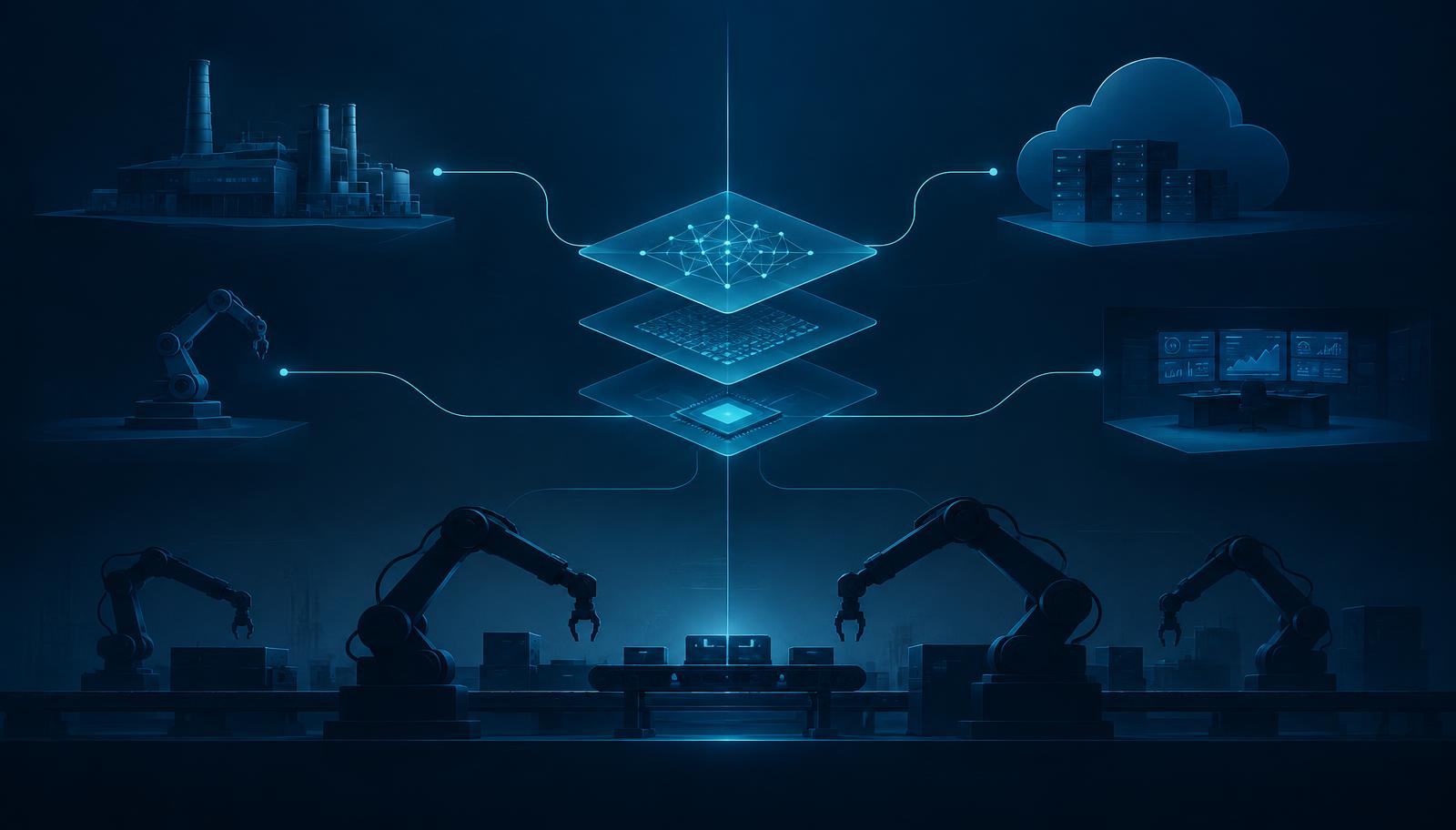
It is a distributed system combining compute, connectivity, data, models, runtime, orchestration, cybersecurity, applications and physical assets.
And all these components evolve.
Hardware ages. Software changes. Models are updated. Vulnerabilities emerge. Operating conditions change and regulation evolves.
The real challenge is therefore not simply making everything work together at deployment.
It is ensuring that the system remains coherent as it evolves.
2. The market is starting to build this architecture
Schneider Electric's announced acquisition of PTC provides an interesting signal.
Viewed in isolation, it could appear to be another major industrial software consolidation move. Placed alongside AVEVA, Cognite and EcoStruxure, however, a broader ambition emerges.
PTC brings product design, engineering and lifecycle management.
AVEVA connects plant engineering and operations.
Cognite contextualizes industrial data.
EcoStruxure connects automation and execution.
Together, they point towards digital continuity across:
DESIGN → ENGINEER → BUILD → OPERATE → MAINTAIN
Schneider describes this as a Digital Thread for the next generation of Industrial AI.
It is not an isolated move. Siemens and NVIDIA are jointly developing what they call an Industrial AI Operating System, connecting design, engineering, simulation, manufacturing and operations.
The pattern matters.
The market is moving from AI capability to AI architecture.
Competitive advantage will increasingly depend not only on who has better models or more compute, but on who can integrate and govern those capabilities inside real industrial systems.
3. AI introduces another lifecycle
The Digital Thread seeks continuity across the lifecycle of a product or asset.
AI now introduces another dimension:
AI lifecycle
- TRAIN
- VALIDATE
- DEPLOY
- INFER
- MONITOR
- UPDATE
- RETIRE
This lifecycle cannot be managed independently.
Changing a model may alter compute requirements, latency, energy consumption or system behaviour. It may introduce new dependencies, change the risk profile or require new validation.
Hardware, software, data, models, cybersecurity and regulation therefore become part of the same problem.
The AI lifecycle cannot be governed independently from the system lifecycle.
This is also where Edge Computing becomes particularly relevant.
The question is no longer simply cloud or edge.
It is:
Which intelligence should run where, under which conditions, and who retains the ability to control that decision over time?
Latency, availability, privacy, connectivity, energy, security and sovereignty all influence the answer.
Edge is where software meets the constraints of the physical world.
4. Deployment is an event. Governance is continuous.
At deployment, we may know the configuration of a system.
Then change begins.
DEPLOY → OPERATE → MONITOR → UPDATE → VALIDATE → EVOLVE
Models, software and configurations change. Vulnerabilities emerge. Threats and regulatory requirements evolve.
This also changes how we should think about cybersecurity and compliance.
Frameworks such as the CRA, AI Act, NIS2 and IEC 62443 introduce requirements around updates, vulnerabilities, traceability, access control, logging and risk management that directly affect system design, although their specific applicability and obligations depend on the context.
Compliance increasingly stops being something we simply demonstrate at the end.
It becomes an architectural property that must be maintained and demonstrated over time.
A trustworthy industrial architecture is therefore not one that is secure or compliant on deployment day.
It is one that can remain governed as it evolves.
5. From Digital Thread to Governance Thread
The Digital Thread seeks to preserve information continuity throughout the industrial lifecycle.
Intelligent systems also need to preserve our ability to understand and control them.
We need to know which components form the system, which versions are deployed, which models are operating, which dependencies exist, which vulnerabilities affect them, what has changed and what evidence demonstrates their state.
We can think of this second continuity as a:
Governance Thread
Digital Thread
- DESIGN
- ENGINEER
- BUILD
- DEPLOY
- OPERATE
- EVOLVE
Governance Thread
- Architecture
- Configuration
- Security
- AI provenance
- Updates
- Risk
- Evidence
- Compliance
Continuity · Traceability · Control
If the Digital Thread connects what an industrial system knows, the Governance Thread preserves our ability to understand, control and trust it as it changes.
This points towards architectures that must not only work.
They must remain observable, traceable, updatable, interoperable, secure and governable throughout their lifecycle.
6. Governance, sovereignty and Physical AI
This connects directly with our first EAIRIS THINKING on technological sovereignty.
THINKING 001, Technological sovereignty: from owning technology to governing itSovereignty does not mean manufacturing every component.
It means retaining effective decision-making capacity over the technologies on which we depend.
Can we decide where our models run? Can we change hardware or providers? Can we operate without permanent cloud dependency? Can we understand our dependencies? Can we update and audit our systems?
In distributed AI infrastructure:
Technological sovereignty becomes an architectural property.
Physical AI makes this even more important.
As AI moves beyond generating information and begins influencing machines and physical processes directly, software changes can create physical consequences.
Architecture, security, observability and governance therefore become fundamental.
The next industrial AI race may not be decided only by who has more intelligence.
It may be decided by who can turn that intelligence into a dependable and governable industrial capability.
The Digital Thread connects what an industrial system knows.
The Governance Thread may determine whether we can continue to trust it as it evolves.
Are we designing Industrial AI systems to work today, or architectures we will still be able to govern tomorrow?
References
- Schneider Electric, Schneider Electric to acquire PTC, creating the next level of Energy and Industrial Intelligence (5 Oct 2026)
- PTC, Form 8-K, Exhibit 99.1, joint announcement of the transaction (5 Oct 2026)
- Siemens, Siemens and NVIDIA expand partnership to build the Industrial AI Operating System (6 Jan 2026)
- NVIDIA Newsroom, Siemens and NVIDIA Expand Partnership to Build the Industrial AI Operating System (6 Jan 2026)